

Every business has a picture in mind of their “perfect customer.” Maybe they’re young professionals with disposable income, or busy parents who love convenience, or small business owners willing to invest in quality. Sometimes these assumptions are spot-on… but more often than not, they’re incomplete, outdated, or simply based on wishful thinking.
And when your marketing is built around a persona that doesn’t reflect reality, you’ll feel it quickly: ads underperform, leads are inconsistent, conversions stay low, and campaigns just don’t “click.”
This is one of the biggest hidden reasons why digital marketing fails.
Not because the ads were wrong.
Not because the channel was wrong.
But because the audience assumptions were wrong.
This article discusses why client-defined “ideal customers” often don’t match real-world buyers, why personas should be treated as a living document (not a bible), and how testing helps businesses continuously refine their strategy.
If you’re a business owner or marketing decision-maker, this may be the mindset shift that finally helps your campaigns scale. And if you’re an agency professional, it’s the conversation your clients need to hear, even if it’s a tough one.
The persona problem: why assumptions don’t always match reality
Most businesses create buyer personas with good intentions. They want to understand their audience. They want focus. They want clarity. That part is great.
The problem comes when personas become rigid-when the business believes that the persona is the truth, instead of a starting hypothesis.
Here’s why this happens so often:
1. Personal bias creeps in – Founders often assume their customers think the way they do. Or that people buy for the same reasons they would. This creates personas based on personal preference, not market behavior.
2. Aspirational customers overshadow logical customers – Many brands define the customer they want, not the customer who’s actually ready to buy. For example: a premium cookware brand dreams of Michelin-inspired home chefs… but data shows the real buyers are busy families who just want durability.
3. Personas get outdated quickly – Markets evolve fast. Behavior changes fast. Search intent changes fast. A persona created 3 years ago can be almost irrelevant today.
4. Internal storytelling becomes “truth” – Teams repeat the same customer story so often it becomes part of the company identity-whether or not the data supports it.
Don’t get me wrong: personas are helpful, absolutely. But they’re not reality. They’re assumptions. And assumptions need to be tested, stress-tested, challenged, and rewritten.
What happens when personas don’t match market reality
When the ideal customer doesn’t match the real one, the symptoms are easy to spot, but maybe hard to acknowledge:
- Ads show impressions, but few clicks
- Clicks don’t convert
- Qualified leads are scarce
- Sales teams complain about lead quality
- Messaging feels “off” in performance tests
- High-intent audiences aren’t being targeted
- Budget is wasted on the wrong segments
Here’s a simple example: a business insists their target audience is men aged 25–35 with disposable income. But the campaign data reveals that:
- Women convert better
- Ages 40–55 show higher purchase value
- A lower-income segment is more responsive to long-term value messaging
If the campaign were locked to the original persona, the business would never discover these more profitable audiences.
This is why testing is essential. This is why flexibility matters.
And this is why a “perfect customer” is only perfect after it’s validated by the market.
Data always reveals your real buyer (even when it surprises you)
Digital marketing is brutally honest. Numbers don’t care what the PowerPoint deck says. Analytics don’t care what a brand believes. Ad performance doesn’t care what the founder envisioned.
Data tells the truth every single time.
Here are the types of insights that quickly reveal whether the persona is realistic:
Demographic breakdowns – Who actually clicks? Who actually converts? Often very different groups.
Search terms from real users – People may search using words the business never anticipated (or disagrees with!). Their language > internal brand language.
High-performing creatives – Sometimes the messaging the client dislikes performs the best. Sometimes imagery they never considered resonates strongly.
Conversion paths – Analytics reveals user behavior that defies expectations:
- Mobile vs desktop
- Peak buying hours
- Multi-step journeys
- Dominant traffic sources
Relative cost per customer segment – Even if two groups convert at similar rates, one may cost 40–60% less to acquire. That’s game-changing for strategy.
This is why a good agency never takes personas at face value. We use them as hypotheses, then run experiments to validate or refine them.
Personas and positioning documents are living documents, not scriptures
Some businesses treat their positioning document like a sacred text.
But markets don’t care about sacred texts. Markets shift. Competitors enter. User behavior evolves. Economic pressure changes buying patterns. Platforms change algorithms. New trends reshape priorities.
A persona written two years ago might simply not reflect today’s buying reality. Your persona should evolve as fast as your market does.
Here’s the healthy way to look at it:
Old mindset: “We have our persona. This is who we target. Period.”
Modern, effective mindset: “We have a starting persona. Let’s test it, refine it, and update it as we learn more.”
The brands that win are the ones that constantly validate and adjust-not the ones holding onto a fixed identity.
If you’re already thinking “we should probably revisit our buyer persona,” that’s a good sign. (And if you want help, let’s discuss and maybe we can work together.)
How agencies should communicate this to clients (without starting a war)
Telling a client their persona is wrong (or incomplete) is delicate. But it’s necessary. The trick is to frame it in a constructive, collaborative way.
Phrase it as opportunity, not contradiction – Instead of “Your persona isn’t correct,” say: “We’re seeing real potential in a segment we hadn’t considered before.”
Use data to guide, not opinion – Clients rarely argue with clear, visual metrics. Let the numbers speak.
Show the impact, not the issue – Instead of focusing on the mismatch, focus on what could improve:
- Lower acquisition cost
- Better conversion rate
- Higher lead quality
- More scalability
Update the persona together
Refinement should feel like teamwork, not correction.
Most importantly: set the tone early. At campaign onboarding, make it clear that personas are provisional and will be refined with data.
This avoids surprises later and builds trust from the start.
Real-world examples (generic, but very common)
Example 1: The premium product that converts best with budget buyers
A brand wants to position themselves as “premium.” But analytics shows the strongest engagement comes from value-seeking customers focused on durability, not luxury.
By adjusting the messaging to emphasize longevity instead of exclusivity, their conversion rate jumps.
Example 2: A startup is certain their audience is 25–35
Campaigns show the 45–60 demographic has triple the conversion rate. Once the company embraces this insight, revenue climbs.
Example 3: B2B company targeting managers, but it’s actually specialists taking action
Decision-makers weren’t engaging, but technical staff were downloading resources and influencing purchases. Shifting the strategy led to stronger pipeline growth.
These patterns happen across almost every industry. The real customer rarely matches the assumed one perfectly-and the gap between assumption and reality is where performance lives or dies.
The hidden risks of ignoring market reality
When a business stubbornly sticks to its “ideal customer” despite evidence that the real one is different, the consequences add up:
- Wasted ad spend
- Misaligned messaging
- Low conversion rates
- Slow sales cycles
- Frustrated sales teams
- Wrong channels or formats
- Poor-quality leads
- Reduced revenue growth
- Blaming the agency instead of fixing the strategy
Sometimes businesses think marketing is failing… when actually the persona is the real culprit. It’s hard to admit, but the sooner you do that, the sooner you can start seeing better results.
The upside of redefining your ideal customer
On the other hand, embracing a data-informed persona unlocks huge benefits:
- Higher ROI
- Lower customer acquisition costs
- More precise targeting
- Stronger messaging resonance
- Better-performing creatives
- Clearer sales conversations
- A scalable, predictable funnel
- Faster market fit
- A brand aligned with real-world behavior
This is the difference between “pushing ads” and “building growth.”
A simple framework for continuous persona validation
Here’s a practical flow that any business or agency can follow:
Step 1: Start with your initial persona – This is your baseline.
Step 2: Run broad tests – Include additional segments to allow the data to guide you.
Step 3: Analyze patterns – Who engages? Who converts? Who costs less?
Step 4: Adjust messaging and targeting – Refine creative, keywords, and positioning based on insights.
Step 5: Update the persona – Rewrite or extend the customer profile based on evidence.
Step 6: Share learnings with stakeholders – Transparent communication builds trust and alignment.
Step 7: Repeat quarterly – Persona updates should be part of your normal marketing cycle-not a one-time project.
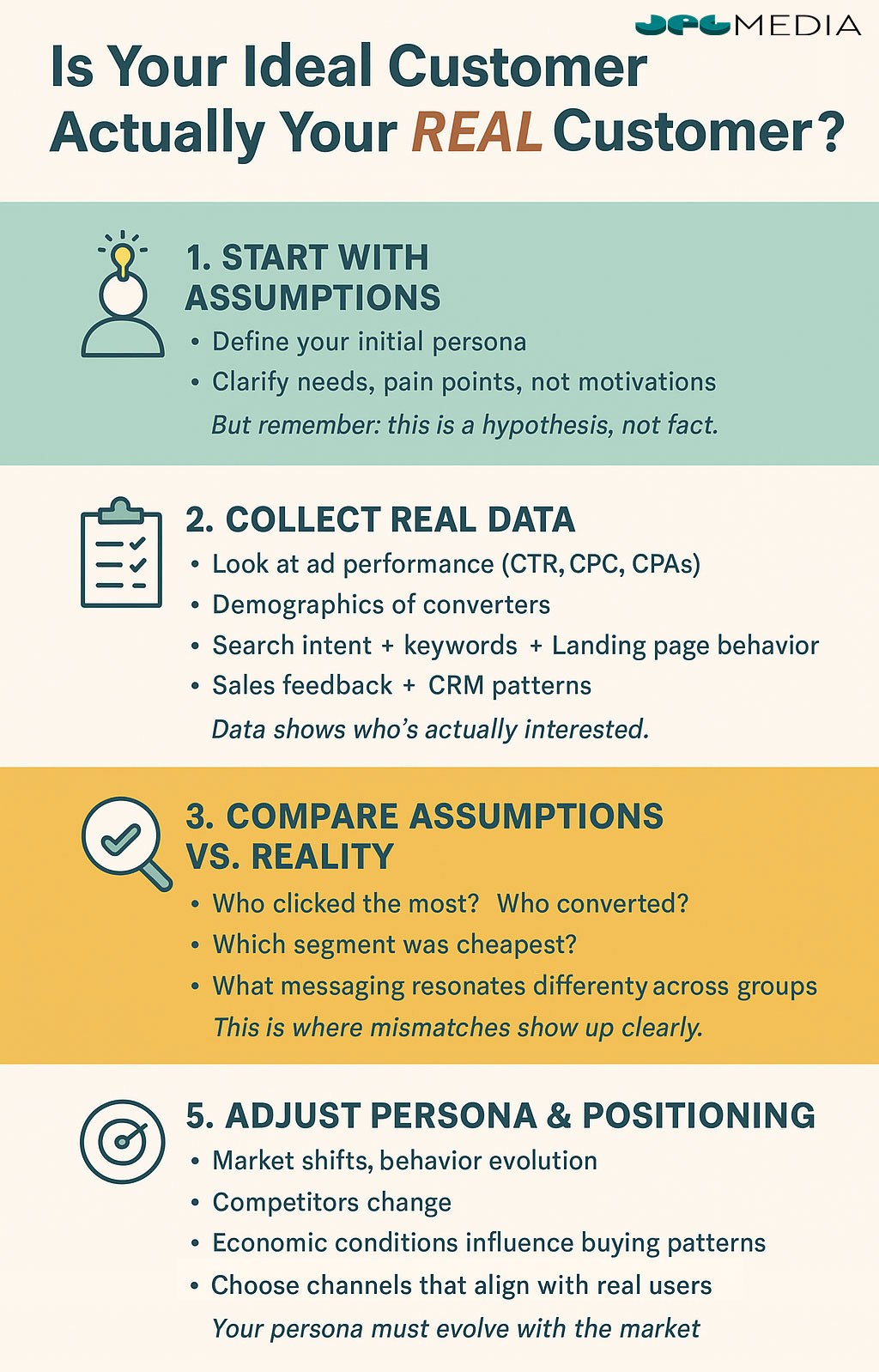
This ensures your marketing is always grounded in what works today, not what worked – or was assumed – years ago.
Final thoughts: let the market tell you who your customer really is
Personas are incredibly useful… but only when treated as flexible, evolving tools.
Your ideal customer is not who you imagine. Your ideal customer is the one:
Who responds.
Who converts.
Who buys.
Who comes back.
Who tells others.
That is your real audience.
And you only discover them through ongoing testing, open-minded analysis, and a willingness to evolve by admitting you can be (very) wrong with your initial assumptions.
If you’re ready to test your assumptions, refine your targeting, and build marketing that aligns with actual customer behavior, not internal guesswork let’s discuss. Come work with us.
We can help you turn data into clarity, clarity into strategy, and strategy into growth you can depend on.
